
Why my website is one page now
Fifteen pages, three designs, one chatbot. In August I cut my website down to a single page. Here is what I learned about leaving things out.
 AI-generated: this text was written by an AI.
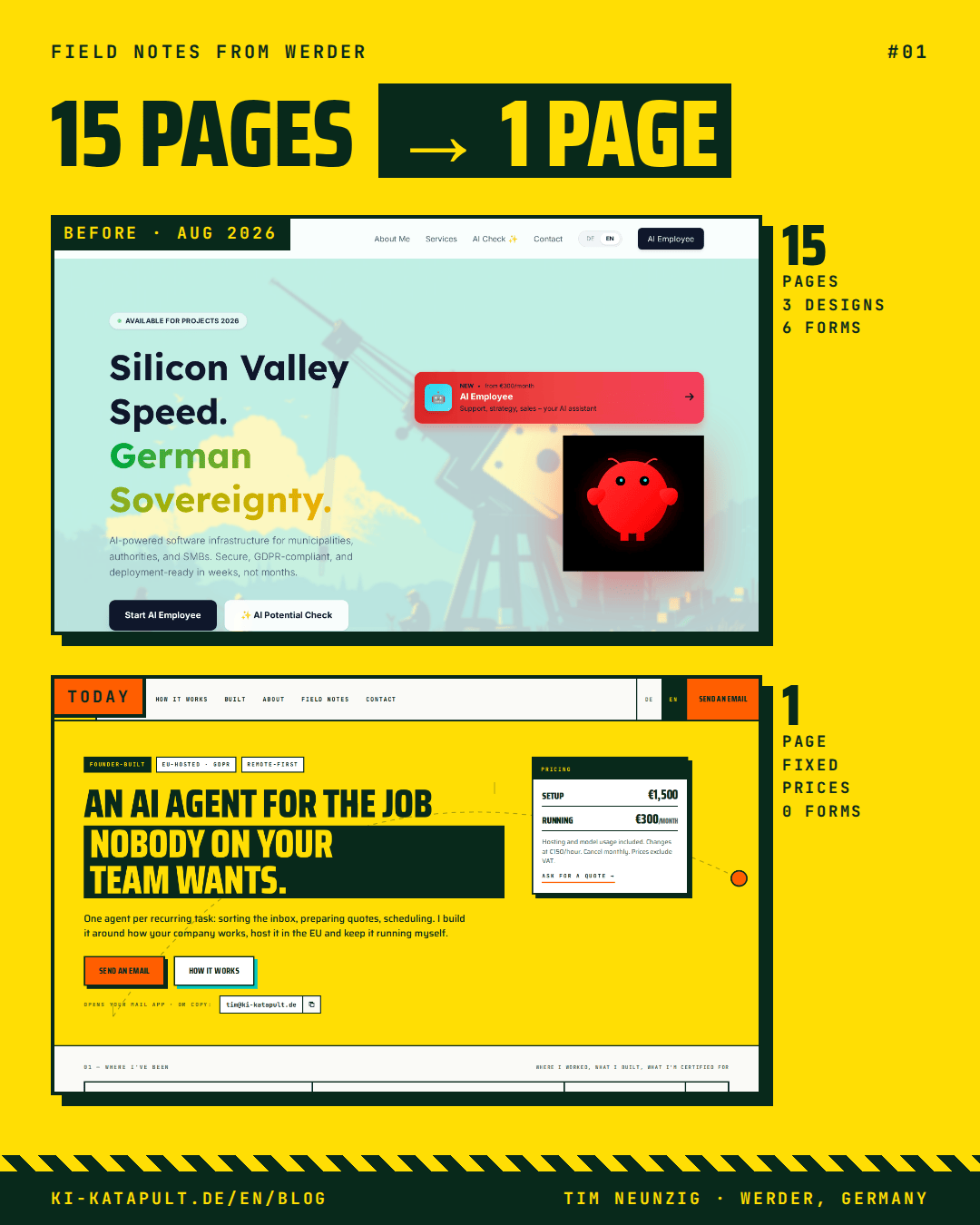
At the end of August I counted the pages on my own website. Fifteen. Eleven of them were trying to sell something, four were legal notices. The homepage headline said: "Silicon Valley Speed."
Who is that line for? A carpenter in Werder, the small town near Berlin where I live? A forty-person accounting firm in Potsdam? A founder in Lisbon who wants someone to automate their inbox? They all want to know what I do, what it costs and how to reach me. On my site, they had to dig for it.
Today ki-katapult.de has one page in German, one in English, and the legal pages. I see the same pattern in almost every company I work with, which is why this is the first field note.
How it got that way
Every page had a reason. A page for "AI employees" because the topic was hot. One for OpenClaw setups because people kept asking. A consulting page, a developer page in English, and an English twin for almost every German page. Plus an "AI check", a chatbot that asked visitors questions about their business.
From the outside it looked like three different companies. The service pages were cyan with rounded corners, the homepage was mint with six accent colors, the legal pages were barely designed at all. Every page carried its own styling in the code. Changing one color meant editing ten places, and usually doing it twice because of the twins.
I didn't notice for a long time. I only ever looked at the page I was working on.
What I cut
For every page I asked one question: would the owner of a fifty-person company miss it?
Mostly not. The service pages became four cards on one page. I switched off the developer page, and the chatbot too. I had no patience left for maintaining an AI chatbot that asked visitors the same questions I ask in the first call anyway. All old addresses redirect to the new page, so an old link doesn't end on an error page.
Two things I kept and rebuilt.
The first is pricing. Prices were on the old site, but scattered: ranges on the consulting page ("€1,500–3,000", "€2,000–5,000 per month", "individual, based on effort"), monthly prices on another page, one more number on the homepage. If you wanted to know what a project costs, you had to compare three pages and still didn't get a number. Now every service has a fixed price, in one place. On the English page that means an agent costs €1,500 to set up and €300 a month to run, hosting and model usage included. I've come to think a price range puts people off almost as much as no price at all.
The second is how you reach me. The old site had contact forms on six pages and a booking link on top. Now there is no form. You click a button, your own mail app opens with a prepared message, and you fill in the highlighted parts: your company, your team size, the task that keeps eating your time. My site stores nothing. The email goes straight to me, and the address sits next to the button for anyone on a phone without a mail app.
The design changed as well: the bright yellow from my logo, heavy dark lines, no rounded corners. I call the direction "mechanical engineering, not software". I build tools for companies, so the page should look like a tool.
The building part was fast
On August 26 I decided on the new direction. On August 27 the new site was live, with the English version, the redirects and rewritten legal pages. An AI coding agent wrote the code. I made the calls, reviewed and corrected.
Deciding took longer. Which page goes, which sentence stays? No AI could do that part for me. What it did was make sure a decision was live the next day instead of some time next quarter. This time, building was the smaller part of the job.
What this means for your company
In the companies I know, the pattern rarely lives on the website. It lives in the software stack.
A tool was added because a problem was urgent. Then another one. Each made sense on its own. A few years later there are seven subscriptions, customer data in three places, and one spreadsheet holding it all together. Every change has to be made in several places. Rebuilding used to be expensive, so things stayed that way.
That has changed. Adapting software, merging two tools or replacing a subscription with something of your own now costs a fraction of what it used to. What's left is the question of what you actually need, and what you only do because it has always been done that way.
That question is also where my agent work starts. I build one AI agent per recurring task: sorting the inbox, preparing quotes, scheduling. Before I build anything, I look at how your team works today and what can simply be dropped. Sometimes the right agent replaces two tools instead of becoming the third.
Fifteen pages mostly created work, for me when maintaining them and for visitors when searching them. Whether one page also brings more inquiries, I don't know yet. I'll check in three months and write it up here.
Labelled under Art. 50 of the EU AI Act: an AI agent wrote this text following my instructions.