
I had to prepare a school placement differently than I expected.
A student placement raised questions about learning goals, the agreement, supervision, privacy and insurance. AI helped me organize and draft the paperwork.
 AI-generated: this text was written by an AI.
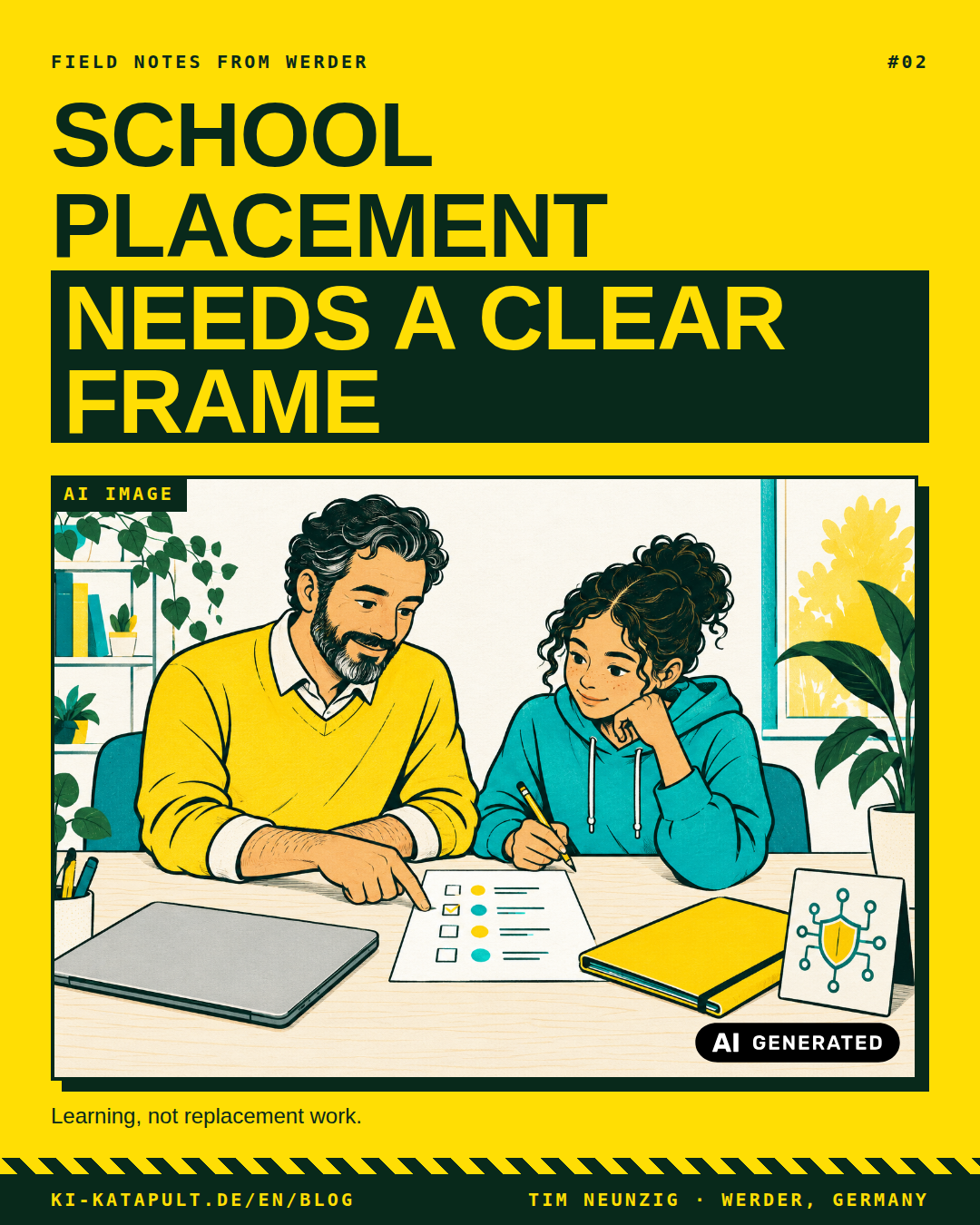
I thought first about the agreement.
Then I realized that a school-arranged student placement is not simply the same thing as a vacation internship. I had to understand what we were actually agreeing to. The point was not to fill a few days with whatever tasks were available. The student was supposed to learn.
That sounds obvious. It still needed to be written down.
I started listing the things I needed to clarify. What would count as learning? Which tasks could the student try, and which should remain off-limits? How would we handle privacy? Could photos or audio recordings be made? Who would handle supervision and care? And what did we need to do about insurance?
There were questions about the nature of the placement, too. It was not intended to replace a worker or pay someone to cover a gap. There would be no remuneration. I wanted the document to make the purpose clear: a student was coming to learn, not to fill a place on a rota.
The agreement ended up five pages long. That may sound like a lot of paperwork for a placement. To me, it showed how many separate questions I had not yet put in the right order.
Define the frame before drafting
The agreement was not the starting point. It was the result of sorting things out. I had to say what the student could observe and try, what he should not be expected to take on, and what we needed to consider. Only then could I draft the text.
The legal classification was not something I could settle with one sentence in a document. A school-arranged placement and a vacation internship are not identical, as I learned. So I gathered the information for this specific case and followed up on open questions rather than copying a generic template and hoping it fit.
Insurance did not come with an automatic letter that answered everything, either. We had not received a notice from the statutory accident insurer. So we contacted the VBG ourselves and started the process for statutory accident coverage for the intern. I also asked my own insurance broker for help and arranged a separate liability policy for the association.
What an organization has to report depends on its responsible accident insurer and the specific situation. The VBG advises employers to clarify whether unpaid placements need to be reported with their responsible insurer. The practical lesson for me was simple: if I have a concrete question, I should not wait for a letter before asking it.
I am not writing this as legal advice. I cannot turn one association's experience into a rule for every organization or every kind of placement. I can say which points I had to clarify and that I contacted the VBG directly.
AI helped gather information and draft
I used AI while researching and preparing the agreement. It gathered information and produced a draft. Then I asked a second language model to review that draft.
That gave me a useful starting point for a topic that had felt scattered. But two models do not turn a draft into a binding answer. The second model was another review pass, not the authority responsible for the decision. I still had to decide what belonged in the agreement and what I needed to confirm with the VBG.
For me, this was a useful application of AI: it helped organize information and put a first version into words. It did not decide what the student should learn, who would supervise him, or which insurer was responsible in this particular case.
That distinction matters in a company, too. A text model can prepare a first draft. Before using it, you still need to know what the document is meant to do, which facts belong in it, and who checks the result. Otherwise the tool just produces confusion faster.
An internship needs a learning goal
The student is meant to understand what a volunteer association does and how it works. For me, that also includes how we use AI. I want him to get some hands-on experience with AI agents: as tools that can help with tasks, and as something like a colleague whose suggestions still need to be checked.
That does not replace supervision. An AI agent cannot take responsibility for a teenager or look after him. The human part is part of the learning goal: understanding what the tool can do, where it can be wrong, and when a person has to make the decision.
I learned something in preparing for the placement, too. Not just what to put in a document, but how important it is to state the purpose of a task first. A school placement is not a vacation job under another name. It needs a frame that makes learning, care and responsibility clear.
Next time I take on a new task in the association, I want to ask earlier: what should the person learn? What responsibilities am I taking on? What do I still need to clarify before the first day?
Those are not questions AI can answer for me. But it can help put them on one page so I am less likely to miss something important.
For the next placement, I would start that list earlier. First, write the learning goal in one sentence. Then name the tasks that fit it. After that, mark the points I need to confirm directly with the school or the accident insurer. Only when those pieces are clear does it make sense to finish the agreement. That makes it easier to see whether the document describes the real arrangement or just looks complete.
This is also where an AI agent can be useful. It can gather recurring questions, organize a first draft or prepare a checklist. It cannot decide which responsibilities I am taking on. That difference may sound small, but it changes what I should ask the tool to do.
I did not want to offer the student a place and leave it at that. I wanted him to see how an organization works and how AI can be used in it. To make that worthwhile, I first needed to be clear about what I expected from him and what he should expect from me.
Sources
- VBG, “Statutory accident insurance during internships and vacation jobs”: https://www.vbg.de/cms/_Resources/Persistent/c/9/7/d/c97d8c8a611dc07afbd9f4fb58d285605501c672/Infoflyer_Praktikanten_und_Ferienjobber.pdf
Labelled under Art. 50 of the EU AI Act: an AI agent wrote this text following my instructions.